
Do you remember the atmosphere of the betting shop, before everything moved to a screen? The low murmur of conversation, the rustle of the racing paper, the sound of the pen scratching against a betting slip. There was a weight to it, a texture you could feel. It felt like an event. You took your slip to the counter, exchanged a few words with the cashier, and waited. It was a small ritual, a bit of theatre in the middle of an ordinary afternoon. I find myself thinking about that a lot these days, especially when I see newer online platforms pop up. It feels like a different world entirely, one measured in taps and swipes rather than the slow turn of a newspaper page.
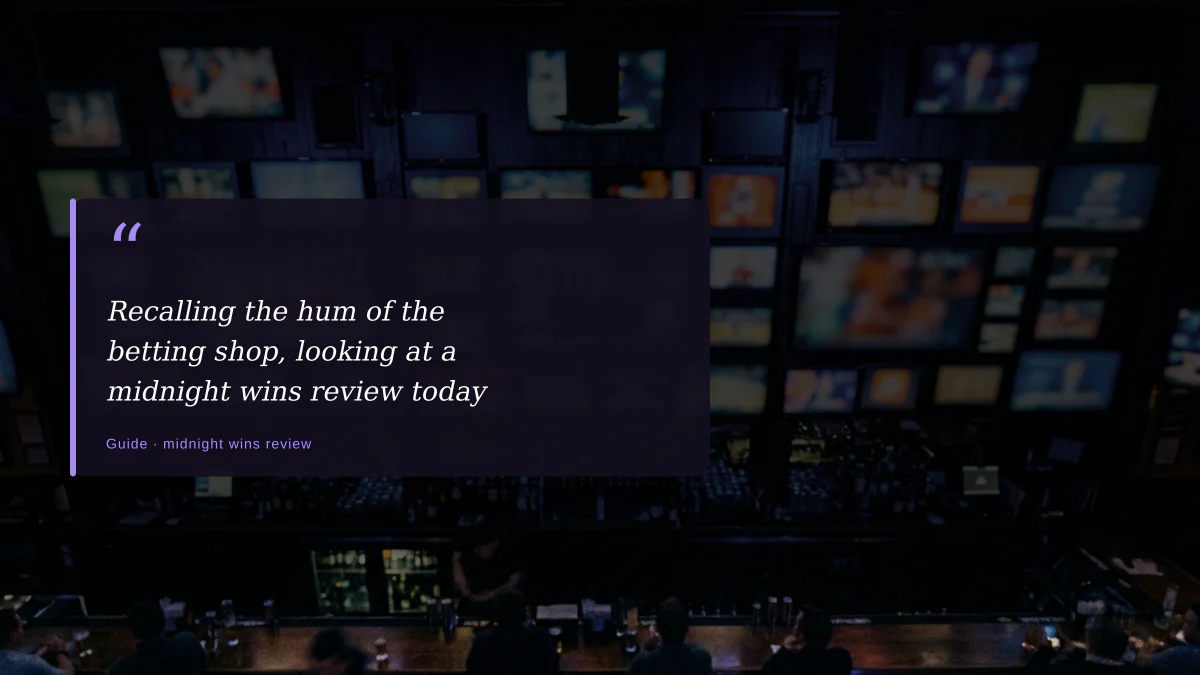
People still want to place a bet on the football or pick a horse, of course. The games are still the games. But the setting has changed beyond recognition. I was reading a midnight wins review the other day, and it struck me how much the description was about speed and access and convenience. All true, no doubt. All very useful. But it made me think about what is not there anymore. The warmth of that old space, the shared silence before a big race, the camaraderie of a bad loss on a rainy Tuesday. That is the stuff you cannot put into a website’s features list. It is the colour that faded when the lights went out on the high street shops. midnight wins
Modern sites have to follow strict rules set by the UK Gambling Commission. They talk about safety tools like GamStop and ask questions about your spending. That is responsible, and it is right. But it feels a bit like talking to a very careful accountant. The old counter chat was about form and weather and a hunch. Both have their place, I suppose. One tries to protect you from yourself with cool logic. The other simply existed alongside your passion, for better or worse.
Placing a bet then and now
The act itself has been stripped down to its bare mechanics. You would study the paper, perhaps listen to the radio commentary in the shop, make your choice. Writing it down made it feel definite. You handed over cash. You got a physical ticket. That ticket was your proof, a tiny, flimsy contract. If your horse came in, you took that ticket back, and the cashier would count out your winnings right there. You felt the notes in your hand. It was immediate. There was a conclusion to the story. Today, you click a button. Money moves between digital accounts you never see. A win is just a number that gets bigger in a box on a screen. It is clean, it is fast, but it lacks a certain gravity. The connection between action and consequence feels thinner, almost theoretical.
Online, platforms focus on making this process as smooth as possible. They accept debit cards, PayPal, or Apple Pay. You can fund an account in seconds from your sofa. For those wanting discretion, Paysafecard works too. It is all very efficient. But I miss the ritual of it. The walk to the shop, the moment of decision at the counter, even the wait for the result felt like part of the experience. Now the experience is just the result. The middle has been hollowed out.
Knowing the game and knowing the player
In a local bookmaker, they got to know you. Not in a data-mining sense, but in a human one. The regular cashier might note you favoured a certain football team or had a soft spot for long-shot horses in the 3:30 at Kempton. It was not used to target you with promotions; it was just a bit of local knowledge, a nod of recognition. They knew your face. There was a relationship, however slight. Online, the knowledge is all in the code. The system tracks what you play, how much you stake, when you log in. It uses that to try and keep you engaged. It is clever, but it is not knowing. It is calculation.
This shift changes the feeling of playing. You are not a person in a familiar place; you are a user profile on a server. The platform’s job is to present games clearly, process payments securely, and ensure everything meets the UKGC’s rules on fairness and self-exclusion. It does its job. But the soul of the thing, the messy, human, social part of it, that existed in the space between people. That is harder to find on a website.
Finding the game you want
Choice was different before. The shop had its boards with the day’s sports: the football coupons, the race cards, maybe a bit of greyhound racing. You looked at what was there. Your choice was bounded by those physical limits. Now, a site like the one in that midnight wins review offers thousands of slots and live dealer games from countless software studios, all day and all night. You can jump from a classic fruit machine simulation to a cinematic adventure slot in two clicks. The variety is staggering. It is like comparing a village library to the whole of the internet. But sometimes, with fewer options, you looked more deeply. You studied the form for that one race because it was the main event of the day. Unlimited choice can feel like having no direction at all.
The sound of winning and losing
The soundscape of the betting shop was unique. The rhythmic chatter of the horse racing commentator from the TV screens, the sudden groan or cheer from a corner when a goal went in, the clatter of the odds updating on the electronic boards. Silence meant concentration. Noise meant something had happened. You felt the mood of the room shift. Online, it is just you and your device. You might have the commentary on, but it is a private stream. A big win is a flash on your screen and a cha-ching sound effect, if you have the sound on at all. A loss is a quiet disappearance of your stake. It all happens in a bubble. You do not share the high with a roomful of celebrating strangers, nor do you suffer the low with a collective sigh. The emotion is muted, made personal and solitary.
Safety and the sense of duty
This is where the modern world is unequivocally better, and rightly so. The old shops did little to stop someone in trouble. You might get a wary look if you were placing too many desperate bets, but that was it. Today, the rules are clear and enforced. Credit cards are banned for gambling in the UK. Sites must offer and promote GamStop, the national self-exclusion scheme. They run affordability checks, asking for details of your finances if your pattern suggests you might be spending beyond your means. It can feel intrusive, a cold shower on the fun. But it comes from a place of duty. The operator has a legal and moral responsibility to protect its players. That midnight wins platform, like any other licensed site, has to build these checks into its fabric. It is no longer just a service; it is a regulated guardian of sorts. The trade-off for 24/7 access is this layer of protective oversight.
Keeping some colour in a digital world
So where does that leave us? The digital platform is here to stay. It is convenient, packed with choice, and safer by design. For someone looking to understand a modern option, a glance at a midnight wins review shows a service built for today’s habits. It is a legal, regulated platform operating under the UKGC’s watchful eye, offering the payment methods people use now. You can find your favourite slots or bet on the football without leaving the house. But for those of us who remember the old way, it can feel a bit flat. The challenge for these digital brands is not just to be efficient, but to find a way to put a little of that human colour back in. Not the smoke and the noise, but the sense of occasion, the slight personality, the feeling that you are somewhere, not just anywhere online. It is a tall order. Perhaps it is impossible. But I think it is worth remembering what we left behind, even as we appreciate what we have gained. The heart of gambling was never really about the machinery; it was about the hope, the story, the shared moment. That bit, at least, we can try to keep alive, wherever we play.
Exploring the features of a modern site often leads you to consider how the entire model functions, from deposits to game selection. In that context, seeing how a brand like midnight wins positions itself can be instructive for understanding the current market’s direction.